
Why the Colour of Engine Coolant Matters: Part 2

In Part 1 of this two-part article, we discussed the reason why Toyota uses pink engine coolant, which some readers might have found mildly interesting. Now, in Part 2, we will discuss whether (or not) a coolant stain is evidence of a coolant leak, as well as which components in modern Toyota cooling systems require the exclusive use of OEM-grade pink engine coolant. Let us start by attempting to answer this question-
Is it a leak, or not?

This writer would suggest that the pool of coolant under this vehicle is most definitely the result of a severe coolant leak, but with coolant leaks, things are not always what they seem.
Take this example of a situation we have all been in at some point in our careers. We perform an inspection as part of a log book service, and we discover what seems to be a leaking (non-electrical) water pump. There is some dry coolant residue on the engine below the pump, so we report our findings to a service writer who then works up a repair estimate, which includes a few service items.
The service writer then contacts the customer to obtain authorisation to replace the water pump as part of the service. After discussing the total cost of the pump replacement, the customer asks a very reasonable question, seeing that the pump replacement can take about seven hours. The question is this “Do I have to replace the pump now, or can it stand over for a while?’
So now, you, as the responsible technician are placed on the spot. Do you recommend immediate replacement of the pump and risk losing the customer because they might think you are ripping them off, or do you suggest that the pump might still work for a few months, and also risk losing the customer should the pump fail soon after the service?
This is a tough situation to be in, but it turns out that Toyota TSB T-SB-103-20 dated October 16, 2020, was released to address this very situation because it offers clear guidance on what Toyota regards as leaks that require immediate attention. This TSB is too big to reproduce here, but consider the images below, which were taken from the TSB document-

Image source:Toyota Motor North America
In this example, the area in the red box shows some dried coolant residue, which Toyota does not consider a valid reason to replace the water pump. Although this is an extreme example, the residue is the result of the small amount of coolant that normally seeps past the mechanical seal in the pump to both lubricate and cool the seal. As shown in the image, Toyota does not recommend replacing the water pump. Now consider the image below-

Image source: Toyota Motor North AMerica
The red boxes in this example show wet, liquid coolant, which Toyota regards as active coolant leaks that require immediate attention, including replacing water pumps and all other affected components.
While this TSB does not remove all the guesswork from deciding whether or not a water pump or other seemingly leaking cooling system component should be replaced, it does provide some guidance and clarity about what should be considered serious leaks. In practice, though, diagnosing and assessing coolant leaks is a grey area that leaves plenty of room for mistakes and misunderstandings, but TSB T-SB-103-20 is a useful authority to cite on inspection reports when we present water pump inspection results to service writers and customers, alike.
Nonetheless, it is worth mentioning one potential pitfall, which is the often tenuous relationship between coolant levels and dry coolant residue around water pumps, coolant hose joints/attachment points, and other cooling system components. The fact is that neither low coolant levels, nor dry coolant residue is necessarily evidence of a coolant leak. So before we recommend potentially expensive cooling system repairs, it helps to remember that the water components in even Toyota’s Super Long Life Coolant formulations evaporate over time, thus reducing the coolant level.
Thus, in the absence of an active wet coolant leak, the best thing to do is to just top off the coolant level, and recommend that the coolant be replaced at the customer's earliest convenience. Be sure though, to mention the fact that the coolant is so old and degraded that some of it has evaporated, which is affecting its efficacy in protecting the engine against corrosion and overheating.
So, there we have it- Toyota’s views on what constitutes a coolant leak that must be resolved immediately, and what is normal seepage around water pumps caused by the normal operation of a Toyota engine, but having said that, let’s look at other cooling system components that require the exclusive use of Toyota’s Super Long Life Coolant, starting with-
EGR coolers

Image source: https://automotivetechinfo.com/wp-content/uploads/2022/08/EGR-Cooler-A25A-FXS-engine.jpg
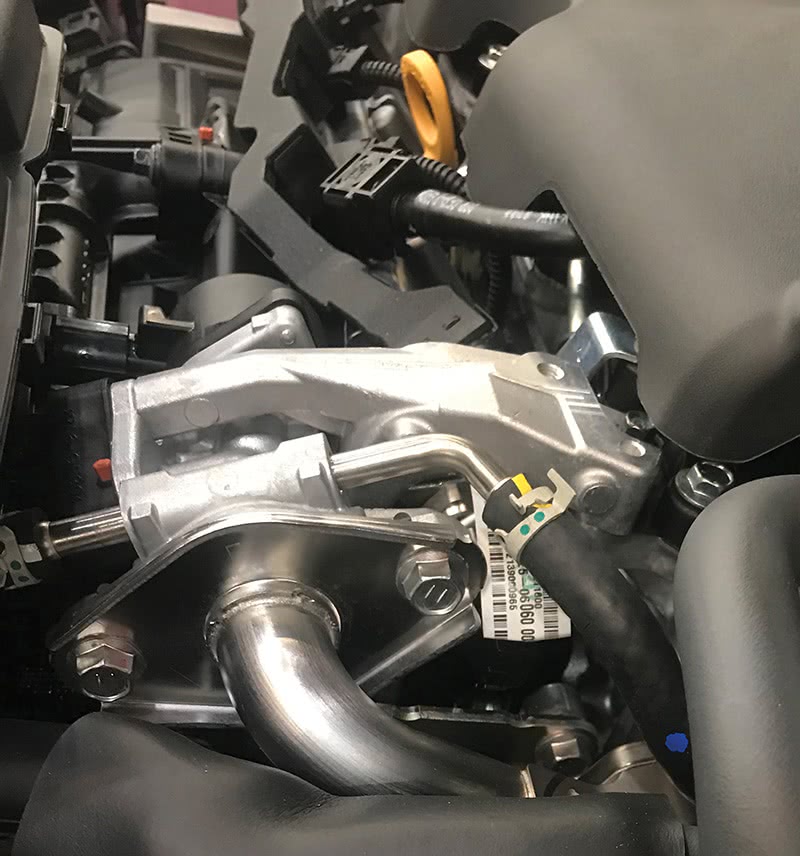
This image shows a partial view of the EGR cooler on a late-model Prius engine, and while we need not delve into what EGR systems do here, we can say that EGR coolers are now fast becoming the norm on progressively more Toyota engines, and so they are no longer the exception they were only a few years ago.
In addition, EGR coolers are not just heat exchangers; these components are now highly optimised to extract the most heat possible from exhaust gas before it enters the engine, and one of the ways in which they do this is to shed heat into the coolant at a predictable rate.
However, heat transfer in modern engines is not an exact science, and much of how effectively heat is transferred into the coolant depends on the coolant’s formulation, which in the case of Toyota’s pink engine coolant, is designed specifically to absorb heat from the exhaust system evenly and consistently. Pure water might do the same thing, as would many other coolant formulations, but the combination of the EGR coolers' design and the chemical composition of Toyota's pink coolant ensures that the exhaust gas passing through the EGR cooler is at least 30 degrees C colder when it exits the cooler than when it was when it entered the EGR cooler.
This drop in exhaust gas temperature ensures that the combustion temperature never reaches the point where NOx forms, which not only reduces harmful exhaust emissions, but also improves the engine’s overall efficiency. While EGR coolers are ultimately emission control devices, they form integral parts of the cooling systems of many modern Toyota engines, and therefore, it is important to ensure that the cooling system is filled with the correct coolant to ensure the proper operation of the ER cooler.
It is worth noting however, that thermal cycling and long use often cause EGR coolers to crack or fracture along an internal surface, which if it happens, creates a coolant leak that can be very difficult to locate because the only visible symptom is often only a very slow drop in the coolant level. In more serious cases, you might see steam emerging from the tailpipe that may or may not be accompanied by misfires on one or more cylinders, especially when the engine is hot.
As might be expected, engine overheating and potentially fatal engine damage could occur if a leak in the EGR cooler persists for long enough to reduce the engine coolant level to below a critical level, which brings us to
Exhaust Pipe Heat Exchangers
Third and fourth-generation Prius engines are fitted with exhaust pipe heat exchangers that use the heat of the exhaust gas to warm the engine coolant to reduce engine warm-up times as an emission control measure.
This component works like an EGR cooler, but in reverse, and while it is reasonably effective in reducing both emissions and engine warm-up times, it depends on Toyota's Super Long Life Coolant to work as both designed and expected. Here is how Toyota describes the exhaust heat exchanger in their TIS (Technical Information System)-
- The exhaust heat recirculation system (exhaust heat recovery unit) consists of a heat exchanger, exhaust gas control valve and exhaust gas control valve actuator
- Engine coolant is circulated to the exhaust pipe in order to heat it. With this, the engine warm-up time has been reduced and fuel economy is improved. Also, the time taken for the heater to become effective in winter is reduced
- The exhaust gas control valve is opened or closed by a thermostat on the actuator. The exhaust gas control valve has a mechanism that automatically opens the valve when the engine coolant becomes hot
Although it helps to know how this system works, it also helps to remember that due to both its location and construction, it is possible for engine coolant to leak into the exhaust system and from there into the cylinders to inevitably cause misfires on one or more cylinders, which leaves us with this-
Conclusion
Knowing why Toyota’s Super Long Life Coolant is pink is far less important than understanding how Toyota’s modern cooling systems work, and how using the wrong coolant can affect the operation of some cooling system components on modern Toyota engines.
In fact, some drivability issues on many modern Toyota vehicles often stem directly from cooling system issues caused by unsuitable or degraded engine coolant. While this connection is not always clear or obvious, referring to service information and TSBs relating to cooling system issues will make it a whole lot easier to diagnose and resolve some drivability issues that do not seem to have any explainable causes.